
27 July 2026 / 4 minutes of reading
The Biggest Summer Risk May Not Be a Hacker
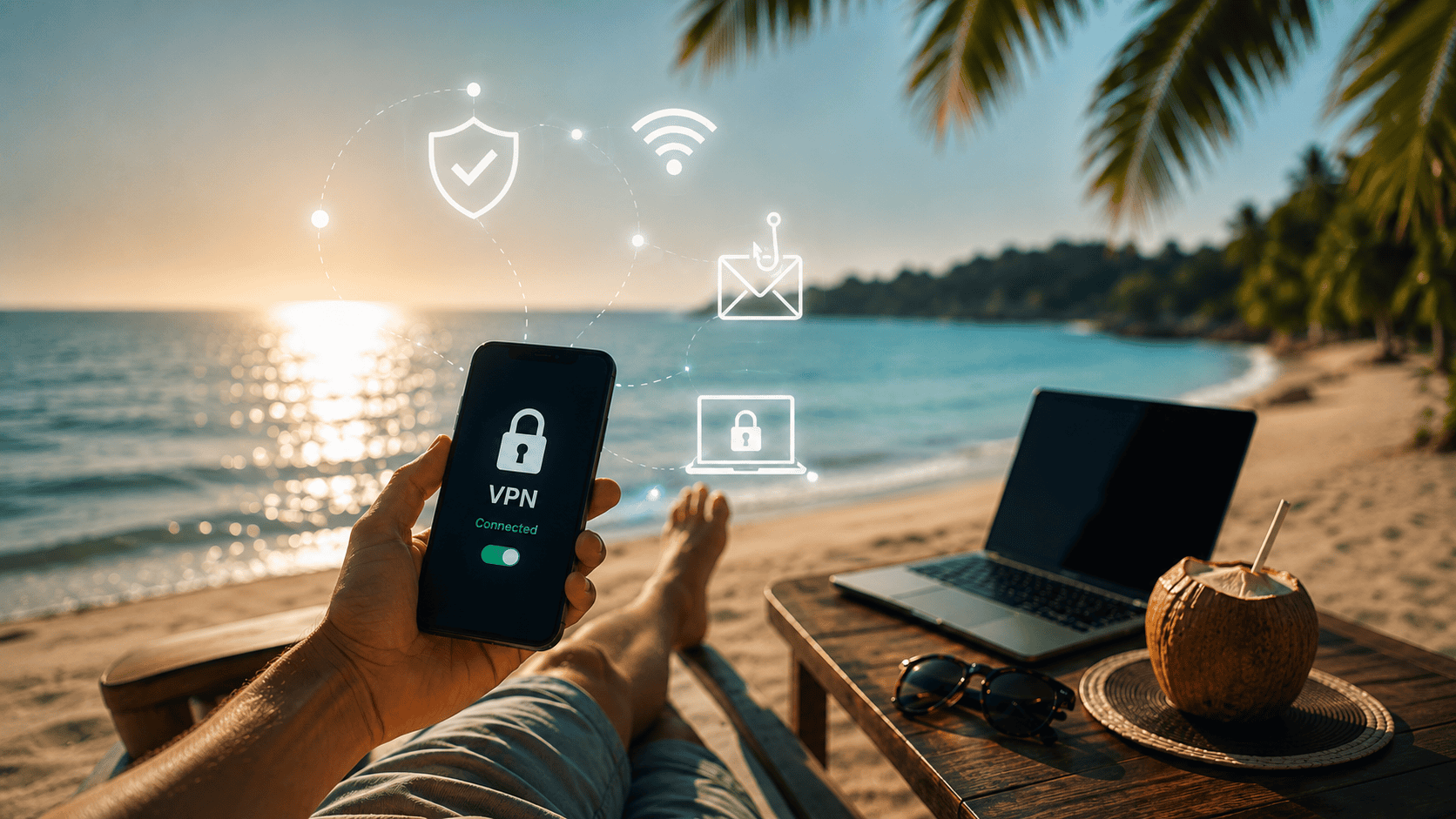
Here are 9 practical security tips to help keep your laptop and data safe this summer. Cybercriminals don't take vacations. Learn why the summer months create unique cybersecurity risks and how to protect your organization while employees work remotely or travel.
When people think of a cyberattack, they usually imagine a skilled hacker trying to break through an organization's defenses. In reality, things are often much simpler. Many security incidents don't happen because attackers discover sophisticated vulnerabilities, but because they take advantage of everyday situations that become more common during the summer.
The holiday season changes the way people work. Employees are away from the office, connecting from hotels, airports, and cafés, relying more on mobile devices, and handling work between travel and leisure. As attention naturally shifts away from work, attackers see an opportunity.
Cybercriminals don't take vacations. In fact, summer often works in their favor. Teams are smaller, key decision-makers may be away, and security incidents can take longer to detect. It only takes one careless click on a phishing email, connecting through an unsecured Wi-Fi network, or losing a laptop for an ordinary situation to become a serious security incident.
What's interesting is that most of these risks have little to do with sophisticated hacking techniques. More often, they result from a combination of human error and everyday business circumstances. Attackers don't always need to exploit complex vulnerabilities. They simply wait for moments when people are distracted, working from unfamiliar locations, or assuming that nothing could possibly go wrong.
That's why organizations should view cybersecurity as more than just a collection of technologies. Firewalls, EDR solutions, and multi-factor authentication are all essential, but they are only part of the equation. Devices need to be kept up to date, sensitive data should be encrypted, and employees must know how to recognize suspicious situations even when working outside the office. Security controls should work just as reliably in an airport lounge or by the pool as they do in the office.
That's why we recommend following a few simple practices during the holiday season to reduce the risk of a security incident.
9 practical security tips:
1. Avoid public Wi-Fi whenever possible
Use your mobile hotspot or a trusted VPN instead of unsecured hotel, airport, or café networks.
2. Enable multi-factor authentication (MFA)
Strong passwords alone are no longer enough. MFA provides an additional layer of protection even if your credentials are compromised.
3. Encrypt your devices
If your laptop or smartphone is lost or stolen, encryption helps protect sensitive corporate data from unauthorized access.
4. Enable remote wipe
Make sure company devices can be remotely locked or erased if they fall into the wrong hands.
5. Back up your data before travelling
Regular backups help minimize the impact of lost devices, ransomware attacks, or accidental data loss.
6. Stay alert to travel-related phishing scams
Attackers frequently impersonate airlines, hotels, booking platforms, and payment providers. Always verify unexpected emails before clicking on links or opening attachments.
7. Don't postpone security updates
Install operating system and application updates before you leave. Delaying security patches unnecessarily increases your exposure to known vulnerabilities.
8. Keep company data out of personal cloud storage and public AI tools
Sensitive business information should remain within approved corporate environments, not personal cloud accounts or publicly available AI services.
9. Think before sharing your location on social media
Posting holiday photos in real time can reveal more than just where you are. It may also indicate when key employees are away or when company offices are less closely monitored.
Summer is also a good time to verify whether your security controls are truly effective. Changes in working habits provide an opportunity to see how well your organization can operate securely outside its normal routine. Testing your security under these conditions can reveal weaknesses before attackers do.
A holiday should be a time to relax, but cybersecurity shouldn't take a vacation. The biggest summer risk is often not a sophisticated hacker, but an ordinary situation that's easy to underestimate. The good news is that most of these incidents can be prevented with a few simple precautions and the right security measures in place.
Other interesting articles
All news




Sign up for our newsletter for all the important cybersecurity and ethical hacking news.
© 2024 citadelo AG. All rights reserved.


